
How Normal Becomes Dangerous
- J Regalado

- May 5
- 4 min read
Before you even get to the plane, consider the actions you took getting to the airport.
You probably rolled through at least one stop sign. You didn't run it, just slowed down enough to look both ways and keep on moving. Maybe you even speed by five or ten miles an hour, matching the traffic around you. Certainly changed lanes or made a turn without signaling because the road was empty and the signal felt unnecessary. None of these registered as conscious decisions, they were just routine, normal, ordinary.
This is where normalization of deviance begins. Not in the cockpit, not in the tower, but in our everyday actions. The ordinary friction between rules and reality. Rules are black and white, written for a purpose, and typically after bloodshed. However, reality says you can see the intersection is clear and stopping fully costs you ten seconds.
You make the tradeoff. Nothing happens. You make it again.
What is Actually Happening
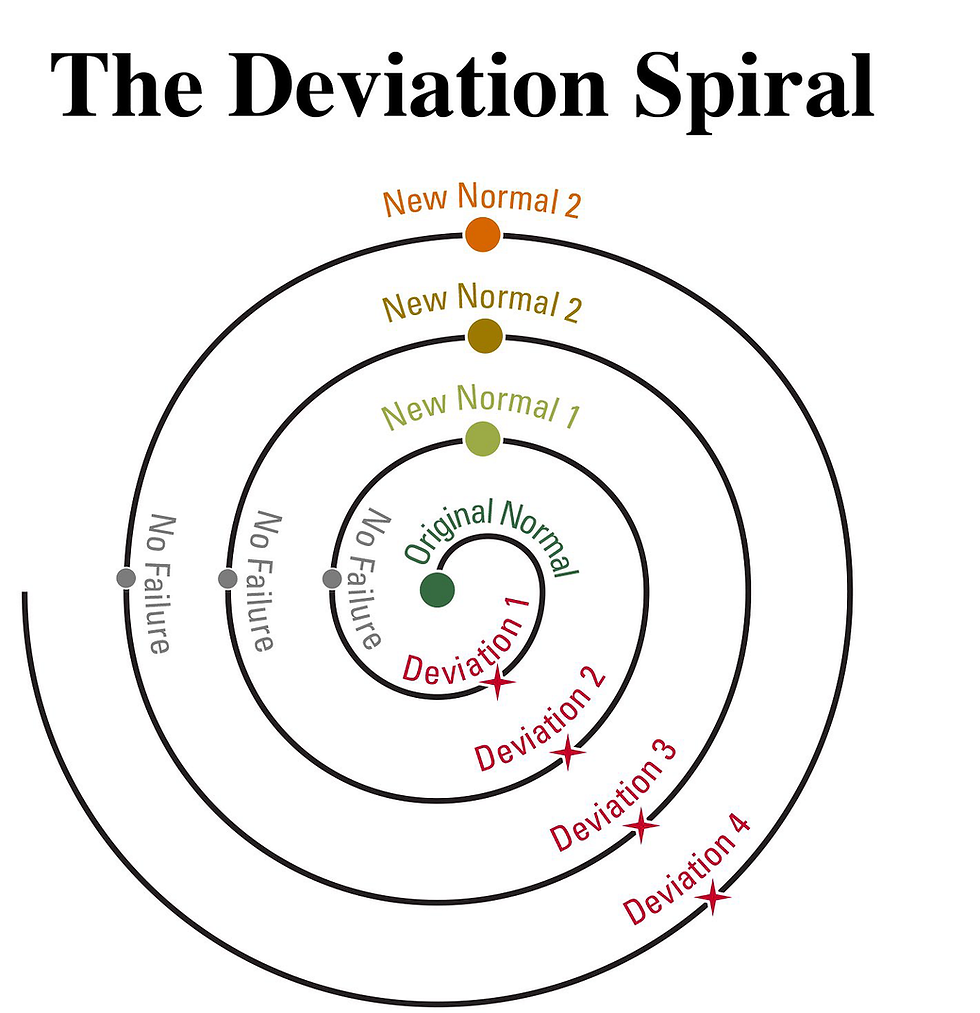
After the Space Shuttle Challenger disaster, a federal investigation produced a report that cited O-ring Defects as the primary cause. Out of this event, reform was was made. Many reflect on the term "group-think" and how it plagued the engineers and managers. However, Diane Vaughn, an American sociologist, took another perspective about the disaster. She argued that the NASA engineers and managers were not negligent in the way we think. They had watched the O-rings degrade on previous flights, noted it, documented it, and then launched anyway because nothing catastrophic had resulted. They had noted more than 750 parts that violated their own redundancy criterion, yet only 66 were resolved. They had normalized deviance.
Each time this behavior was repeated without catastrophic results, it became the social norm for the organization. The O-ring concern didn't disappear. It was reclassified. What was initially a potential stop to any launch became an accepted anomaly, then a known characteristic, then background noise.
Vaughan defines the process where a clearly unsafe practice becomes considered normal if it does not immediately cause a catastrophe stating "a long incubation period before a final disaster, with early warning signs that were either misinterpreted, ignored, or missed completely."
It is this incubation period that is the dangerous part. It can last for years, decades even. Invisible to the people in the inside. Until suddenly the bubble pops.
A Window In Aviation
On May 31st, 2014, a Gulfstream IV overran the end of runway 11 at Hanscom Field in Bedford, Massachusetts. The crew had skipped the engine-start and after-start checklist. When they were unable to set takeoff thrust, they recognized the problem and continued anyway. Seventy-five seconds later, seven people were dead.

A review of the Quick Access Recorder (QAR) data by the NTSB determined that the crew skipped the flight control check on 98% of their previous 175 takeoffs. These two pilots were the only crew to fly the aircraft in 2014, logging 150 hours together in the preceding five months with no external check on their habits, no oversight, and no correction. The deviance had been normalized long before that runway.
This is not about one crash, or one crew, or one airplane. It reaches far across our industry. From the experienced pilots like Dale Snodgrass, one of the most decorated naval aviators in history, whose life was taken due to a missed flight control check on a routine airshow demonstration, to American Airlines Flight 191, where a maintenance shortcut, using a forklift to remove the engine and pylon as a single unit, had spread across multiple airlines undetected and unquestioned, until a pylon failed on takeoff from O'Hare and killed 273 people.

Normalization of deviance doesn't discriminate by experience level or aircraft type. It is a challenge that designers, regulators, and instructors continue to wrestle with, because it's one we cannot simply engineer out of the human. And yet, we keep trying, and in doing so, may be making it worse.
Better Systems, More Deviance
There is a compounding effect that the industry has been slow to acknowledge honestly.
As aircraft systems improve, as automation takes on more of the monitoring workload, as glass cockpits provide situational awareness that steam gauges never could, the subjective experience of flying becomes more manageable. Tasks that required active attention now happen automatically. Errors that would have been consequential are caught by redundant systems. The environment feels more forgiving.
A more forgiving environment breeds more deviance. Not because pilots are worse, but because the feedback loop that once corrected small deviations (that is the immediate consequence of getting something wrong) is now buffered by layers of automation and redundancy. Pilots can get away with more. So they do. And the standard drifts.
This is not speculation. It is the same mechanism Vaughan documented at NASA, applied to a system that has become measurably better at absorbing deviations without producing the feedback that would correct them.
The better the system, the quieter the drift. And the quieter the drift, the further it can go before the luck runs out.
__________________________________________________________________________________
Part two examines what training, design, and culture can realistically do about a problem that cannot be engineered out of human beings and what the next generation of pilots is being prepared, or not prepared, to face.

Comments