
"Traffic in Sight": Normalization of Deviance Case Studies

Three words that transfer responsibility. A confirmation that the pilot has acquired the conflict, that the system can move on, that separation is now a human problem rather than a radar problem. Controllers use them dozens of times per shift. Pilots say them without thinking.
Twice in American aviation history, separated by 47 years, those words preceded a midair collision. Not because the crews were careless. Because the assumption embedded in the phrase, that sight equals safety, had been repeated so many times across so many frequencies that nobody questioned whether it was still sound.
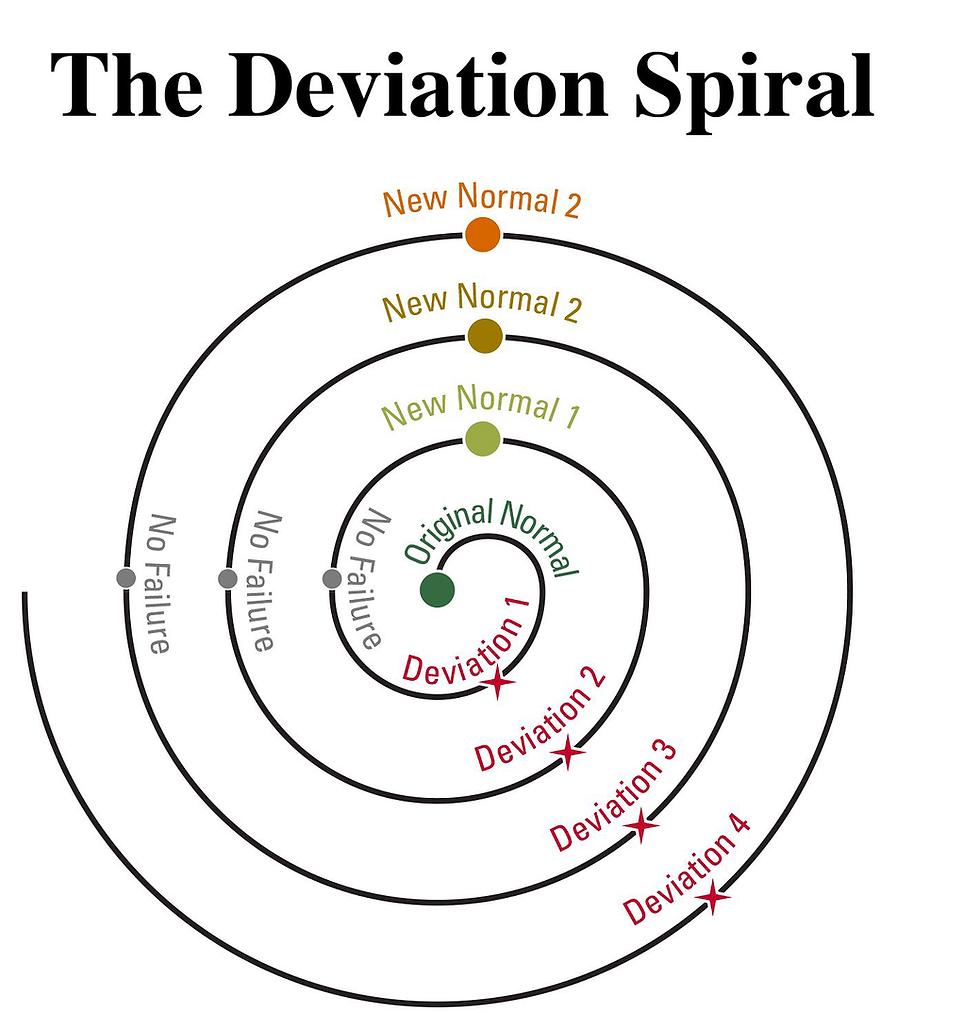
This is what normalization of deviance looks like when it operates at the system level rather than the individual level. Not one crew drifting from a checklist. An entire industry drifting from a principle.
San Diego, September 25, 1978
The morning was clear. Ten miles of visibility, light wind, the kind of day that makes flying feel uncomplicated. PSA Flight 182 was on a visual approach to runway 27 at Lindbergh Field, descending through 3,200 feet, carrying 135 passengers and crew on the short leg from Los Angeles.
Below and ahead, a Cessna 172 from Gibbs Flite Center was climbing northeast, a student pilot and instructor working through ILS practice approaches. ATC had both aircraft on radar. They advised the PSA crew of the Cessna's position. The crew reported traffic in sight. They were cleared to maintain visual separation.
Eighty-six seconds later, the 727 overtook the climbing Cessna from above and behind. The crew had lost visual contact at some point during the descent and said nothing. They assumed they had passed it. The Cessna climbed into the 727's right wing at 2,600 feet over the North Park neighborhood of San Diego.
One hundred and forty-four people died. Seven more on the ground.
The NTSB's finding was precise: the flight crew failed to maintain visual separation and failed to inform the controller when they lost sight of the traffic. The FAA responded. Procedures were updated. Controllers were directed to provide radar separation where capability existed rather than defaulting to visual. And at Lindbergh Field specifically, the accident directly drove the establishment of Class B airspace, mandatory positive radar control for all aircraft operating in the area, regardless of size. The lessons were documented, published, and filed.
The assumption that visual separation between mixed traffic was adequate. That if "traffic in sight" was a sufficient transfer of responsibility, was examined, criticized, and addressed.
And then, over the following decades, it quietly drifted back.
Washington D.C., January 29, 2025
Reagan National Airport sits at the intersection of some of the most complex airspace in the country. Commercial traffic on tight approaches to runways that push into the Potomac. Military helicopters operating VFR routes that cross those approach paths. A tower managing both simultaneously, on frequencies that don't always talk to or hear each other.
The normalization had been building for years before the accident. The NTSB found that controllers at DCA had routinely relied on visual separation to manage the interaction between helicopter traffic and landing fixed wing aircraft, not as a contingency, but as standard practice. The helicopter routes ran within 75 feet laterally of the final approach path at minimum separation. FAA safety concerns had been raised internally by controllers and pilots. No action was taken.
On the night of January 29th, an Army Black Hawk on a training mission was cleared through the corridor as an American Airlines CRJ-700 turned final for runway 33. The helicopter instructor pilot reported traffic in sight and requested visual separation. The controller approved it.
The NTSB's reconstruction of the helicopter crew's perspective, using night vision goggle simulation, found they likely never positively identified the airliner. The expectation that the aircraft was lining up for a different runway shaped what they saw, or believed they saw. The report was made. The responsibility transferred.
Sixty-seven people died.
The NTSB's probable cause statement is worth reading slowly: the air traffic system's overreliance on visual separation to promote efficient traffic flow, without consideration for the limitations of the see-and-avoid concept. The FAA's failure to act on known risks. The helicopter crew's failure to effectively apply the separation they had accepted responsibility for.
Between 1978 and 2025, the underlying assumption had never fully been corrected. It had been addressed, papered over, procedurally managed. Yet again under the steady pressure of operational efficiency and the reinforcement of thousands of uneventful transits, it drifted back to where it started.
The Pattern in the Pattern
I flew in that environment. Not at Reagan, not on approaches to Lindbergh Field, but in the same normalized assumption, at a general aviation airport where helicopters and fixed wing aircraft shared a busy controlled pattern.
While teaching students in the traffic pattern, it was routine for a helicopter to request another touch-and-go and tell tower that "all traffic was in sight". The call would go in regardless of geometry. I watched it happen when I was north of the field and the helicopter was south, 180 degrees of separation between us, no line of sight possible by any reasonable interpretation of the phrase. The tower approved the lap. We both kept flying. Nothing happened.
That is not a story about a close call. It is a story about how the assumption sustains itself between the accidents. Every uneventful lap, every approved sequence, every unremarkable frequency exchange reinforced the idea that the system was working. Nobody was intentionally being reckless. The call was made, the words were said, and the airspace kept moving.
The same words PSA 182 used. The same words the Black Hawk crew used.
Traffic in sight.
What the 47 Years Tell Us
The gap between 1978 and 2025 is not a gap in knowledge. The NTSB documented the failure of visual separation as a reliable mechanism for mixed traffic in 1978. The findings were public. The limitations of see-and-avoid were understood, written about, and taught. Every ground school cover the physiological and geometric constraints of the human eye in traffic detection.
The corrections made after PSA 182 addressed the immediate failure mode: a specific crew, a specific approach, a specific tower. They did not address the underlying assumption that had made the failure possible, and they did not prevent that assumption from re-establishing itself across decades of operationally convenient practice.
This is normalization of deviance at its most dangerous scale. Not a pilot drifting from a checklist. A system drifting from a principle. The American Airlines crew didn't have a say. Someone else called traffic in sight, someone else accepted the separation, and sixty-seven people who never knew there was a decision being made paid the price for it. The Black Hawk crew inherited a culture that had been quietly rebuilding it since 1978, and that night, it failed everyone aboard that jet.
Visual separation works. It has worked countless times and will work countless more. But it works only under one condition: that the pilots who invoke it hold those words to their fullest meaning. That traffic in sight means positively identified, tracked, and understood. That the responsibility transferred is actually carried. The moment that standard drifts, even slightly, the tool stops working and the culture starts building toward the next accident.
These words are still being said. Dozens of times a day. In towers and cockpits across the country, the transfer of responsibility happens in three words, and the assumption behind them continues to be reinforced by every sequence that ends without a collision.
Say it like someone's life depends on it. Because it does.


Comments