
Keep the Blue Side Up
- J Regalado

- Apr 28
- 5 min read
Updated: May 5
When you think about the song “American Pie”, what comes to mind first? Is it nostalgia from easier times, scenes of the movie under the same title, or singing around a campfire? The eight-and-a-half minute opus has a special place in my playlist; not only does it bring memories of late night celebration with lifelong friends, but stands as the initial spark that first pulled me into aviation human factors. The song, which serves a bit of a eulogy to the 1960s, centers around the shifting tide of American culture after the fatal crash of Buddy Holly, Richie Valens, and “The Big Bopper” J.P Richardson on February 3rd, 1959, the night Don McLean would later call the day the music died. While many can recite its iconic lines, many don’t stop and look into this accident, and realize how one instrument design can be the difference between life and death.
Roger Peterson, the 21 year old commercial pilot and certified flight instructor who flew Holly, Valens, and Richardson into that Iowa night, was by all accounts a competent aviator. With more than 700 total flight hours, 52 of which were instrument instruction, Peterson carried a broad experience in various different aircraft and instrumentation styles while working for Dwyer Flying Service.That night, he was assigned N3794N, a 1947 Beechcraft 35 Bonanza that was like many of the other Bonanzas Peterson flew for Dwyer, except one thing: the Sperry F3 gyro.
Ask any instrument pilot and they should be able to tell you all about the operation of the Artificial Horizon - How it works, how to interpret it, and how to use it to get out of situations that may lead to spatial disorientation. But hand them an F3, and those skills may deteriorate fast. The F3 Gyro was an engineering solution to a problem that challenged designers for years. When an aircraft pitches nose up, the natural forces acting on a gyroscope push it in the opposite direction, creating a misleading indication. Rather than fighting those forces mechanically, Sperry's engineers worked with them, designing an indicator that moved in concert with those natural inputs. Elegant in theory, yet dangerous in practice, because the result was an instrument that displayed pitch and bank information in a manner that was essentially the reverse of what a conventionally trained pilot would expect to see.
According to the Civil Aviation Board (CAB), the precursor to the FAA and NTSB, and Peterson’s training log, he had no record of receiving training on the F3. So on February 3rd, he climbed into N3794N for the first time, and without any recorded consideration of that unfamiliar instrument, departed into a dark and deteriorating Iowa night.
What Peterson Saw
Go back to the artificial horizon you train in. Keep the blue side up is what is commonly said, referring to keeping the sky representation on top. Nose up, the horizon bar drops. Nose down, it rises. Intuitive, consistent, universal. Now take your same instrument, same panel, same location, but reverse the motions. Pitch up? The aircraft representation goes down. Pitch down? The aircraft moves up. The CAB summarizes it perfectly by saying, “The pitch display of the F3 was the reverse of the instrument Peterson was accustomed to, meaning he could have believed he was in a climbing turn when he was in fact descending.”
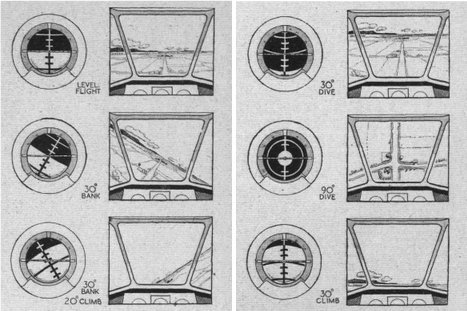
Now take this instrument, and a pilot who has never flown with it into a dark wintry night, and the results are predictable. The CAB found the Bonanza in a 90 degree right bank and a nose down pitch.
What makes the CAB report truly sobering is that the danger was already known. The F3's own guidance warned that pilots trained on a conventional artificial horizon should not rely on the attitude gyro unless they had first gained sufficient experience under simulated instrument conditions.
The CAB went further, noting that the reverse sensing on the F3 doesn't just cause confusion, it causes an instinctive wrong reaction. The more conditioned a pilot is to a conventional horizon, the more dangerous the F3 becomes under stress. Training itself becomes the hazard. Every hour Peterson had logged on a conventional artificial horizon had, in a dark and terrible way, worked against him that night.
The Holes in the Swiss Cheese
This is where the story stops being about Roger Peterson and starts being about something much larger. The swiss cheese model of accident causation, developed by psychologist James Reason, describes how disasters rarely trace back to a single cause. Instead, think of each layer of your safety system as a slice of swiss cheese: policies, training requirements, weather briefings, aircraft instrumentation, operator oversight. Each slice has holes. On any given day those holes don't align. But when they do, tragedy passes straight through unimpeded.
A pilot flew an instrument he had no training on. A weather briefing system failed to pass along a flash advisory describing exactly the conditions Peterson was about to enter. An operator dispatched a night flight into IMC without verifying his pilot's legality or familiarity with the aircraft. And a certified instrument sat in that cockpit with no regulatory requirement ensuring the pilot had ever practiced with it. That night, the holes aligned perfectly.
So Where Does That Leave Us?
Consider what has changed. Attitude indicators are now standardized. The F3 is gone. Weather dissemination is faster and more accurate. Instrument currency requirements are codified. These are real improvements, hard won from accidents exactly like this one.
But consider what hasn't changed. Pilots still transition between aircraft with meaningfully different avionics philosophies (from steam gauges to glass, Garmin to Avidyne, conventional vision to synthetic vision) with minimal transition training. Automation has closed many of the gaps that raw pilot skill used to bridge, but it has opened new ones. Automation complacency, mode confusion, and the erosion of hand-flying proficiency are the F3 problem of our generation. The instrument has changed. The hazard hasn't.
The CAB's warning from 1959 is worth reading again slowly: Do not rely upon any equipment under circumstances requiring its use for the safe conduct of flight until you have acquired sufficient experience under simulated conditions to insure your ability to use it properly.
Swap out "attitude gyro" for "autopilot," or "TCAS," or "ADS-B," or whatever system you last flew with but haven't truly been tested on and then ask yourself honestly whether that warning still applies to you.
Four people died on a dark Iowa field because one layer of the system assumed someone else had closed the hole.
What holes are you assuming someone else has closed?
Read the full CAB report here: https://www.faa.gov/sites/faa.gov/files/CAB_BeechcraftBonanza.pdf

Comments